Turkish grammar can seem daunting at first glance — especially if your only previous language learning experience is with European languages like French, Spanish, or German. But here is the truth: Turkish grammar is governed by two core features, and once you understand them, almost everything else falls into place. Those two features are vowel harmony and agglutination.
This guide explains both concepts clearly, with real examples, no unnecessary jargon, and practical advice on how to use this understanding to accelerate your learning.
Learning the alphabet is step one — the fastest way to actually speak is a structured course with a teacher. Turkish courses in Istanbul and Izmir
Turkish vowels are divided into two groups based on where in the mouth they are produced:
Vowel harmony means that the vowels in a suffix must match the vowel group of the root word they are attached to. If the root word contains back vowels, suffixes use back vowels. If the root contains front vowels, suffixes use front vowels.
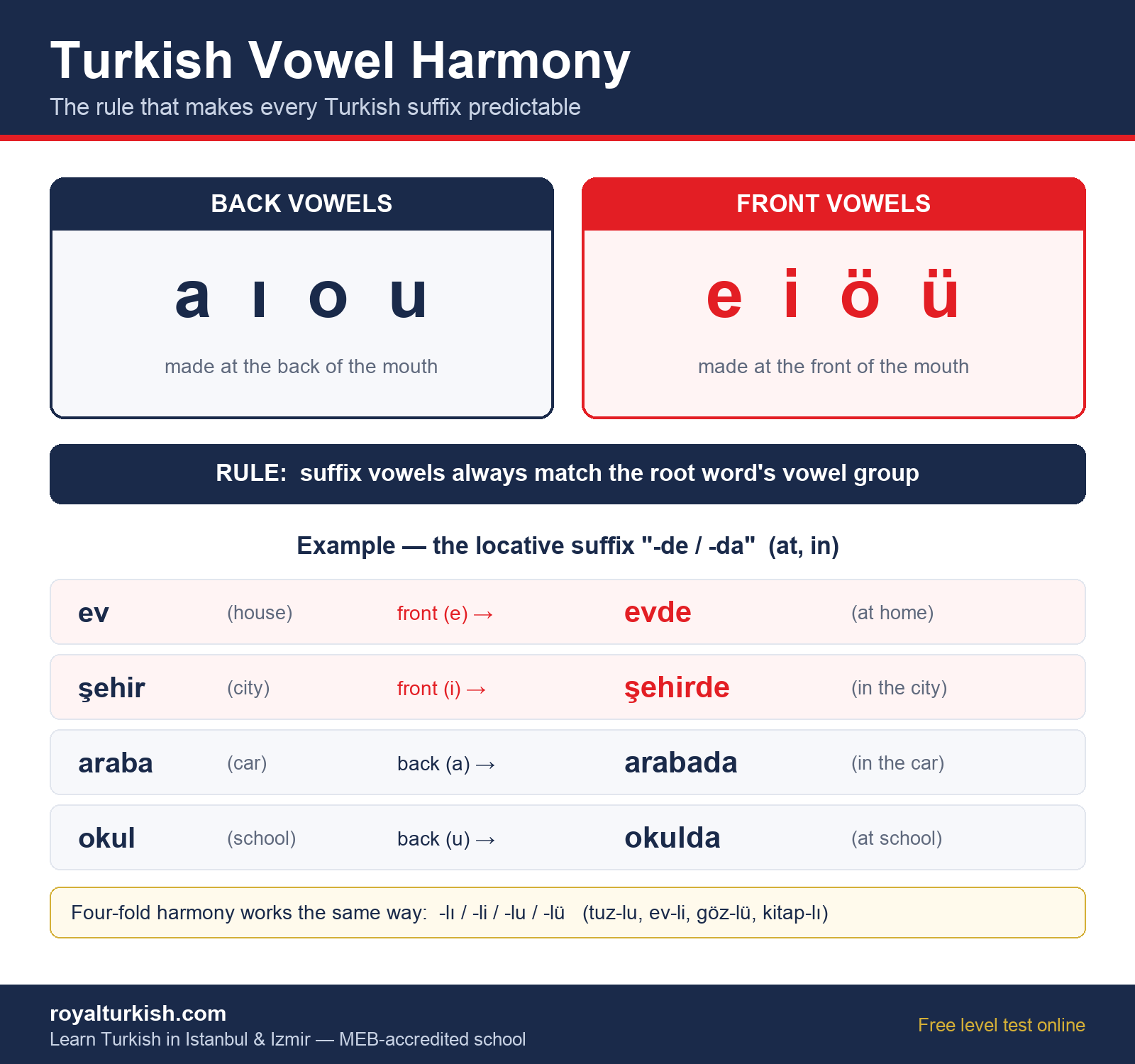
Let us look at a simple example with the locative case suffix (meaning "at" or "in"):
Vowel harmony makes Turkish extremely predictable. Once you know the vowels in a root word, you can predict the exact shape of every suffix that will ever attach to it. There is no need to memorise whether a word takes one suffix or another — the phonetic rule tells you automatically.
This is a significant advantage compared to languages where noun gender determines ending patterns and must be memorised word by word. In Turkish, the root's vowel sound does the work for you. As you progress through the Turkish language levels, you will find vowel harmony becomes second nature surprisingly quickly.
Turkish is an agglutinative language, which means it builds complex meanings by stacking suffixes onto a root word, one at a time. Each suffix adds exactly one piece of grammatical or lexical meaning. The root stays intact, and the suffixes pile up in a fixed order.
The classic example that Turkish teachers love to demonstrate is:
Gidebilecekmisiniz?
This single word means "Will you be able to go?" Here is how it breaks down:
Five components, one word. The order of these suffixes is fixed and consistent across all Turkish verbs. Once you know the suffix slots and what goes in each position, you can construct — and decode — sentences of almost any complexity.
Key insight: Turkish is called an agglutinative language. Each suffix adds exactly one piece of meaning. Once you learn the suffixes, you can build almost any sentence.
English is an SVO language — Subject, Verb, Object. "I learn Turkish." Turkish is SOV — Subject, Object, Verb. The verb always comes at the end: "I Turkish learn."
This feels unnatural at first, but it has an important implication: when you are listening to or reading Turkish, you have to wait until the end of the sentence to know what the action is. This trains you to hold more context in mind while processing language — a skill that becomes automatic with practice.
For more on how this affects difficulty, see our article on whether Turkish is hard to learn.
One of the most welcome surprises for learners coming from French, Spanish, German, or Arabic is that Turkish has no grammatical gender. There is no masculine or feminine category for nouns, and there is no need to learn a gender assignment for every word you encounter.
In Turkish, the word for "he", "she", and "it" is all the same: o. There are no different article forms for different genders. This alone removes a significant cognitive load that learners of Romance or Germanic languages must carry.
The most common mistake new learners make is trying to study Turkish grammar as if it were Latin — memorising declension tables and rule lists. A more effective approach is:
Grammar books can feel overwhelming because they present every rule at once. Our structured courses build from A1 upwards, introducing one or two suffixes per lesson so you can master each before moving on.
If you also like to work through grammar on paper, our own Pusula Turkish textbooks (PDF) build it up step by step from A1 to B1, with a coursebook and a workbook for each level.
Learned the letters? Now make them stick.
Join a live online Turkish course with native teachers — most students read Turkish accurately in their very first lesson. Or practice speaking free with Eda, our AI Turkish tutor.
Vowel harmony means Turkish suffixes must contain vowels that "match" the vowels in the root word. Vowels are grouped as back (a, ı, o, u) and front (e, i, ö, ü), and suffixes follow this pattern automatically.
Agglutinative means Turkish builds words by attaching suffixes to a root. Each suffix adds one specific meaning. The word "Gidebilecekmisiniz?" (Will you be able to go?) is a single word built from 5 components.
Turkish grammar is different from English but internally consistent. There are almost no exceptions to the rules. Most learners find it challenging at first but logical once the core patterns click.
No. Turkish has no masculine or feminine nouns, making it significantly easier than French, Spanish, German, or Arabic in this respect.
Turkish is SOV — Subject-Object-Verb. The verb comes at the end of the sentence. For example, "I Turkish learn" instead of "I learn Turkish."
Turkish has 6 grammatical cases expressed as suffixes: nominative (subject), accusative (direct object), dative (to/toward), locative (at/in), ablative (from), and genitive (possessive). Each case is a fixed suffix, making the system more regular than Latin or Russian cases.
Turkish has no definite article equivalent to "the". For indefinite "a/an", Turkish uses the word "bir" (literally "one"). This makes Turkish simpler than English in one respect — you never need to choose between "a" and "an".
Turkish verbs are built by attaching suffixes to a verb root. Tense, person, and number are all encoded in these suffixes. For example: "git" (go) + "-iyor" (present continuous) + "-um" (I) = "gidiyorum" (I am going). The same rules apply across almost all verbs with virtually no irregular forms.
Most learners find postpositional structure and verb-final word order the hardest adjustments — both require rethinking sentence construction from scratch. Vowel harmony is often described as satisfying once internalised. Long suffix chains in complex sentences can be initially overwhelming but follow consistent rules.
Find your level in 5 minutes, then learn with MEB-certified native teachers in Istanbul, Izmir or online.