Both Turkish and Arabic appear on the US Foreign Service Institute's list of the most challenging languages for native English speakers. But the reasons are very different — and for most learners, one is considerably harder than the other. This guide gives you an objective, category-by-category comparison so you can make an informed decision about which language to pursue.
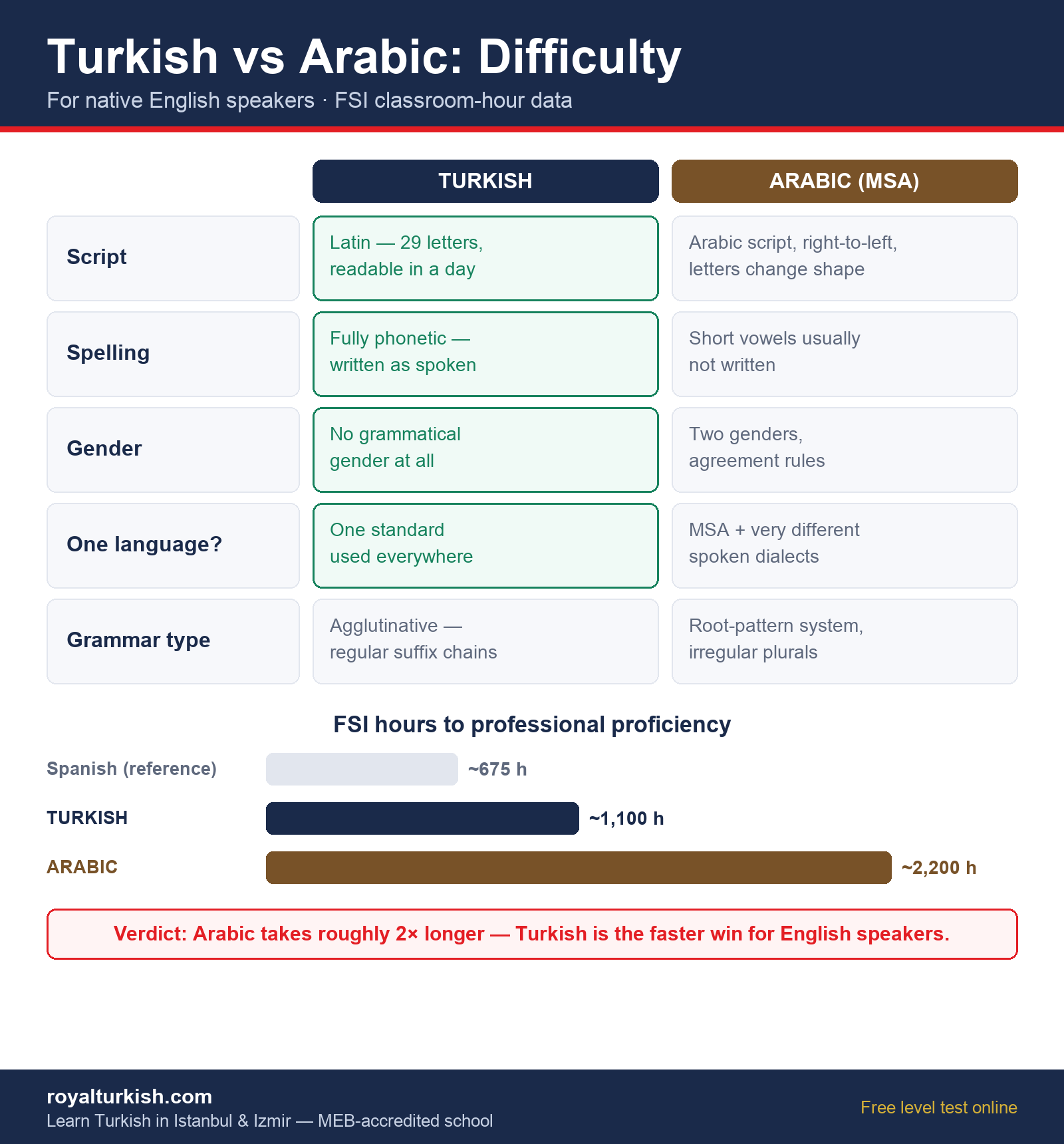
The writing system is often the first thing learners consider, and here the gap between Turkish and Arabic is enormous.
Learning the alphabet is step one — the fastest way to actually speak is a structured course with a teacher. Turkish courses in Istanbul and Izmir
Turkish has used the Latin alphabet since 1928. If you can read this sentence, you can already read Turkish letters. The alphabet has 29 characters — you need to learn the six special letters (ç, ş, ğ, ı, ö, ü) and adjust for a few different sound-symbol mappings, but most learners can read Turkish text within a day or two.
Arabic uses its own script — an abjad written right to left with 28 letters. Short vowels are typically not written at all, which means learners must infer them from context. The letters also change shape depending on where they appear in a word (beginning, middle, end, or standalone). Mastering Arabic script alone takes most learners several weeks to months of dedicated study.
Both languages have grammar systems that differ fundamentally from English, but they differ in different ways and with different levels of internal consistency.
Turkish grammar is agglutinative and suffix-based. It has no grammatical gender, very regular plural formation, and consistent suffix rules governed by vowel harmony. There are few exceptions. The challenge is the unfamiliarity of the system — verb-final word order and long suffix chains — but once you learn the rules, they apply almost universally.
Arabic grammar includes three grammatical genders (masculine, feminine, and a dual form for pairs), a broken plural system (where plurals are formed by changing the internal vowel pattern of a word rather than adding a suffix — and must often be memorised individually), a complex root-pattern morphological system, and significant differences between Modern Standard Arabic and the spoken dialects actually used in daily life.
Turkish has borrowed extensively from European languages, particularly French, Italian, and English. This gives English speakers a useful foothold:
Arabic has almost no vocabulary overlap with English beyond loanwords that entered English from Arabic (algebra, algorithm, coffee, sugar). The core vocabulary must be learned from scratch. One interesting benefit for Arabic speakers learning Turkish: Turkish contains hundreds of Arabic loanwords — kitap (book), kalem (pen), mektup (letter) — which can give Arabic speakers a significant head start with Turkish vocabulary.
Turkish pronunciation is relatively accessible for English speakers. The sounds are distinct and consistent, and the special Turkish vowels (ö, ü, ı) have clear European equivalents in German and French. There are no sounds in Turkish that are genuinely difficult for English speakers to approximate.
Arabic contains several sounds that do not exist in any European language and are difficult for most Western learners to produce: the pharyngeal consonant ع (ayn), the uvular fricative غ, the emphatic consonants that are distinct from their non-emphatic counterparts, and the aspirated ح. Producing these sounds accurately requires specific physical training.
| Language | FSI Category | Estimated Hours | Classification |
|---|---|---|---|
| Turkish | Category III | ~1,100 hours | Hard |
| Arabic | Category IV | ~2,200 hours | Super-Hard |
| Spanish / French | Category I | ~600–750 hours | Easy |
For English speakers, Arabic requires roughly twice as many study hours as Turkish to reach professional working proficiency, according to FSI data. Turkish is hard; Arabic is in a category of its own.
The answer depends entirely on your goals:
If you already speak Arabic, Turkish vocabulary will feel surprisingly familiar in places. But the grammar structures are entirely different, so the advantage is vocabulary-only.
For native English speakers, Arabic is significantly harder than Turkish. The FSI estimates ~1,100 hours for Turkish vs ~2,200 hours for Arabic professional proficiency. Arabic's script and grammar system add considerable complexity.
It helps with vocabulary. Turkish has borrowed many words from Arabic (kitap=book, kalem=pen, mektup=letter). However, the grammar systems are completely different, so Arabic grammar knowledge does not transfer.
Yes. Turkish uses the Latin alphabet (same script as English), which most learners can read fluently within a day or two. Arabic uses a completely different script that takes weeks to months to master.
It depends on your goals. Arabic is spoken by 400+ million people across 22 countries. Turkish is spoken by 90+ million people and gives access to Turkey, Central Asia, and Turkic cultures. Turkish is generally faster to reach conversational level.
No. Turkish and Arabic belong to completely different language families. Turkish is a Turkic language; Arabic is a Semitic language (related to Hebrew and Amharic). They share vocabulary through centuries of historical contact but have no genetic relationship.
FSI data places Turkish at ~1,100 classroom hours and Arabic at ~2,200 hours to reach professional proficiency — roughly double. Both are challenging for English speakers, but Arabic is in a harder category. In immersive study (e.g., living in Turkey), Turkish A2–B1 is typically achievable in 8–16 weeks.
For most learners, Turkish is the better starting point. The Latin alphabet removes a major initial barrier, grammar rules are more consistent, and functional communication is achievable much faster. Arabic requires a larger upfront investment before you can hold basic conversations.
Yes — but only in terms of vocabulary. Turkish has borrowed hundreds of words from Arabic (kitap=book, mektup=letter, kalem=pen, şehir=city). However, Turkish grammar — agglutination, vowel harmony, verb-final word order — is entirely different from Arabic, so grammar must still be learned from scratch.
Find your level in 5 minutes, then learn with MEB-certified native teachers in Istanbul, Izmir or online.